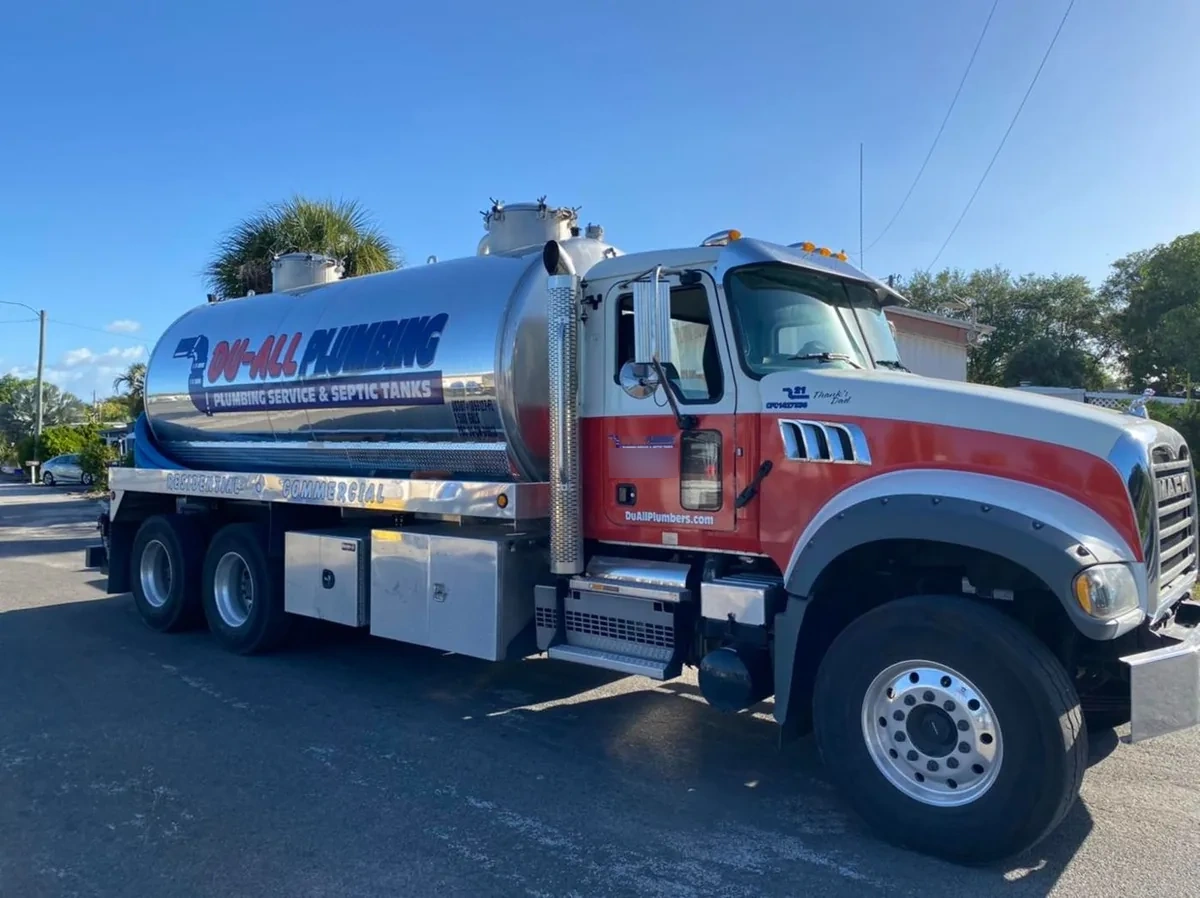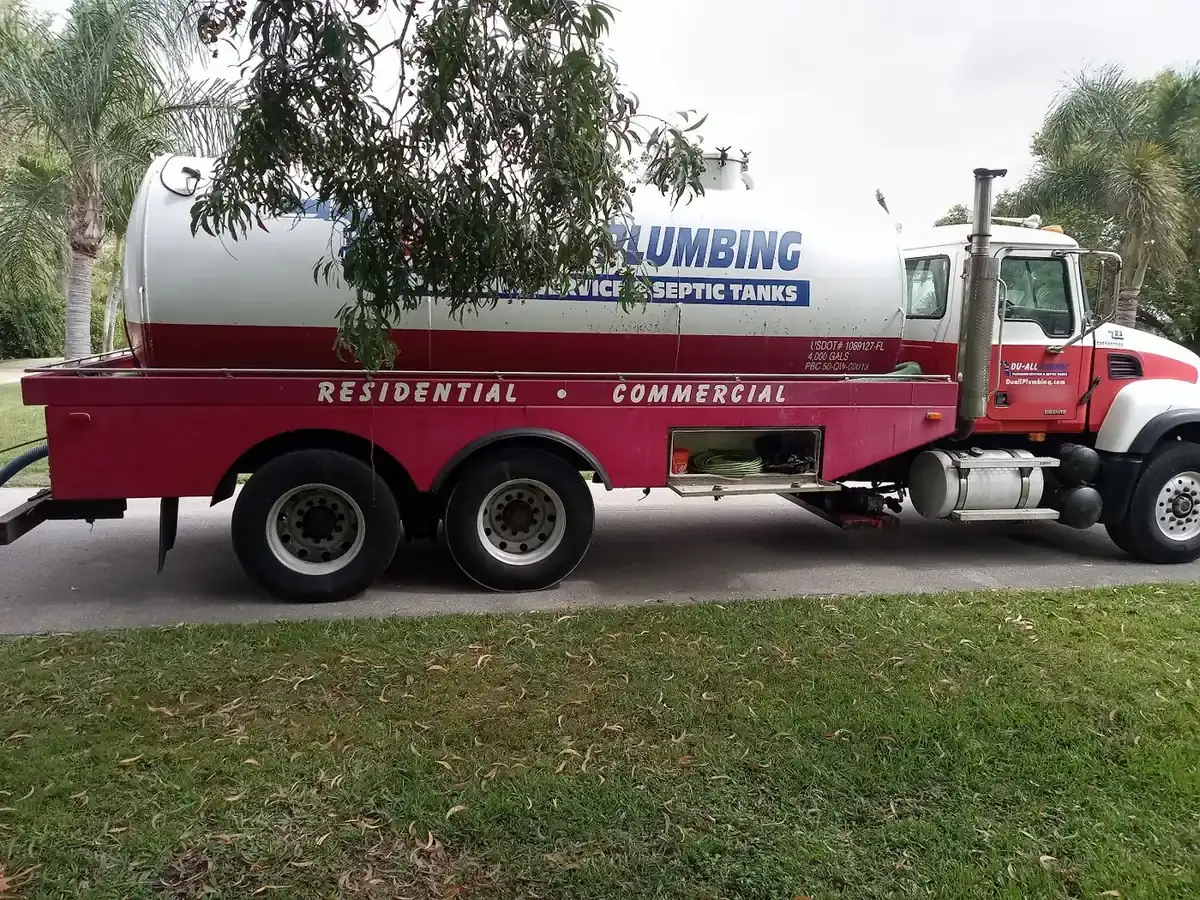
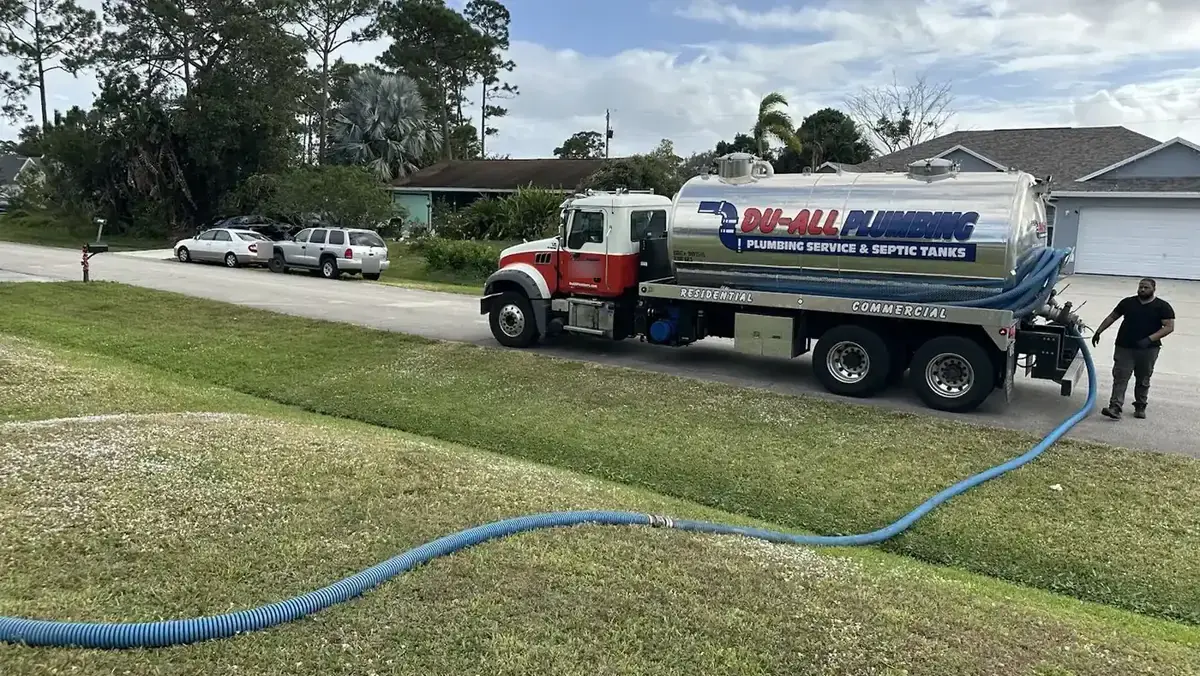
Above ground. Below ground. Du-All.
Septic Tank Pumping St. Lucie Village
Plan the pump-out around your property.
Du-All Plumbing provides septic tank pumping for confirmed septic systems in St. Lucie Village. Du-All Plumbing provides septic tank pumping in St. Lucie Village.
Request service
Tell us what’s happening.
Share your property address and the problem you’re seeing. A Du-All team member will call you to arrange service.
This request does not confirm an appointment. To speak with the team, call 772-238-6456.
 A+ rated by the Better Business BureauView our BBB profile →
4.6/5 on Google348 reviews · Lake Worth BeachRead Google reviews (opens in a new tab)
Quick answer
How do I arrange septic tank pumping in St. Lucie Village?
Du-All Plumbing provides septic tank pumping in St. Lucie Village. Call 772-238-6456 with your address, wastewater-system records and any current symptoms. Ask for pricing and an access review before the visit, so the request matches the tank actually serving your property and any separate drain problem.
Septic tank pumping in St. Lucie Village should combine a defined maintenance task with a careful plan for residential access. The village lies north of Fort Pierce between US 1 and the Indian River Lagoon, crossed by Old Dixie Highway and the Florida East Coast Railway. Du-All Plumbing needs the exact 34946 address, current wastewater record and the symptoms or maintenance goal. The oldest part of the village is a National Register Historic District, but the tank’s service history must come from the property file. Gather prior receipts and explain any changed access before requesting a pump-out or authorizing additional work.
St. Lucie Village septic pumping removes what ordinary flow leaves behind
Household wastewater carries materials that separate in the tank. Heavier solids settle as sludge, grease and floating matter form scum, and liquid between them passes toward the field. Pumping removes retained material before those layers reduce working depth or reach the outlet. Waiting for a backup is not a reliable maintenance plan.
St. Lucie Village’s predominantly single-family residential use and historic district make a long-held home a useful example: ownership may stay the same while household demand changes. Ask what observed accumulation says about the period since service, rather than use the house’s age as an interval.
The septic tank service hub connects pumping. A tank normally contains wastewater, so the professional should explain whether “full” means normal liquid, excessive sludge and scum or unusually high liquid. That distinction supports a sound next step: remove accumulated contents, assess an unresolved flow problem or do both where findings justify it. The emptied condition alone does not establish that every downstream component performs correctly.
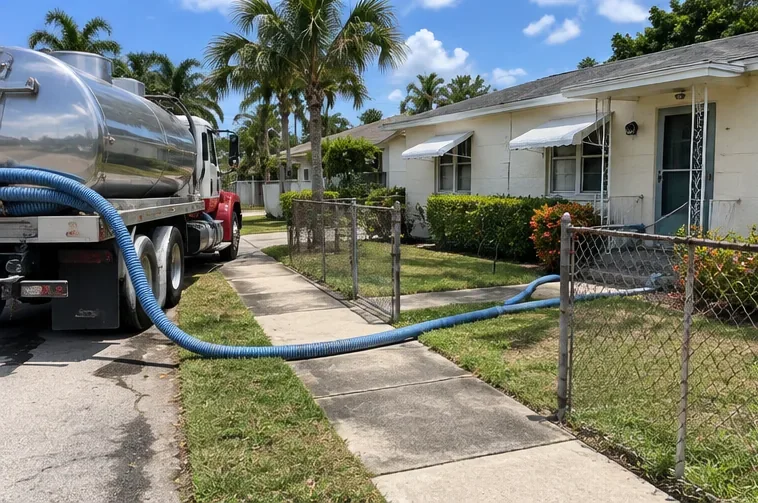
How should St. Lucie Village septic pumping preserve access and treatment?
The village lies between US 1 and the Indian River Lagoon, crossed by Old Dixie Highway and the railway. Its one-way streets and private drives call for the correct authorized approach, but service access should also protect the installation. Do not route vehicles across the tank or drainfield, where loading can damage components and compact the treatment area.
Hunt Avenue, North Indian River Drive and Chamberlin Boulevard appear in the official map. Provide the actual entrance once and explain changed paving near a known opening. If the tank has compartments, ask which are included in the removal task and what access limitation would affect completion. Leave covers to the professional.
The St. Lucie Village plumbing page connects other building services. After pumping, ordinary wastewater naturally restores operating liquid level. A rapid return of actual backup, however, should be interpreted through the pre-service levels and remaining line or outlet condition rather than dismissed as normal refill or automatically treated with another pump-out.
What St. Lucie Village septic pumping symptoms need attention first?
Wastewater returning through a low fixture is a different request from planned maintenance with no current problem. Tell Du-All which fixture changed first and whether several drains react during ordinary use. Reduce unnecessary water use during a backup, avoid contaminated areas and do not repeatedly flush to gather more evidence. Keep tank covers and loaded cleanouts secured.
The St. Lucie Village drain cleaning page provides the related route when a line restriction needs discussion. A tank pump-out removes accumulated material but does not guarantee an unobstructed building line or establish drainfield performance. Ask which part of the reported problem the first task addresses and which findings would require another assessment. On a property with an uncertain wastewater record, clarify the active connection before ordering material removal from an unfamiliar cover. The service decision should follow the actual system and fixture observations, not the age or residential character of the village street.
St. Lucie Village septic pumping when household use changes
Additional residents, visiting family or a home returning to regular use can change the flow reaching a tank. Describe the actual change and timing when discussing maintenance. A vacancy does not remove material accumulated earlier, and a running fixture may add water even when occupancy stays the same. Report unexplained consumption separately rather than expecting pumping to repair its source.
Ask how the known tank characteristics and observed accumulation should influence future maintenance. Avoid an interval chosen only from household size or another owner’s experience. The Learning Center helps prepare questions about pumping and other plumbing concerns. If the owner will not attend the visit, name the person who receives written findings and the person who may approve another task. Keep the completed record with the property documents so a later caretaker or family member can understand the maintenance decision without guessing what equipment was serviced or why follow-up was recommended.
Does St. Lucie Village septic pumping explain wet ground near the lagoon?
The village’s position between US 1 and the Indian River Lagoon provides a clear local orientation. It does not identify the cause of outdoor water at a private property. Report where wetness appears, whether it coincides with drainage trouble and whether water consumption has changed. Stay out of suspect wastewater and keep children and pets away from the affected area.
If a supply leak is a possibility, St. Lucie Village water leak detection is a separate service discussion. Pumping cannot repair a pressurized line or demonstrate by itself that a drainfield accepts flow correctly. Do not divert suspect water toward a public drain or shoreline. If wetness remains after a pump-out, ask what the service findings establish and which assessment can resolve the remaining question. A proposal should explain its purpose before the owner approves repeated material removal or a major repair simply because the first task did not answer every symptom.
What should St. Lucie Village septic pumping mean for later maintenance?
Use capacity, wastewater, solids and actual household use to interpret the interval. A formerly vacant home can still contain earlier accumulation, while a returning household adds new demand. Food waste through a disposal and continuous fixture flow change different inputs. Pumping cannot repair the source of unwanted water.
Spread laundry loads and keep grease and wipes out. Ask what layer observations show about remaining separation space and whether the previous interval allowed material too close to the outlet. That is more useful than choosing a fixed date from bedroom count alone.
If a physical defect is observed, ask which component is affected and what assessment supports repair. The town publishes a notarized-form route through its Building Official for applicable work. Confirm that process for the defined proposal once. Keep the maintenance conclusion distinct: what material was removed, what sections were serviced and whether symptoms remain. A pump-out receipt is not a certification of every private line or field, nor is the home’s historic setting a reason by itself to replace wastewater equipment.
Request St. Lucie Village septic pumping with the property file ready
For a separate address south of the village, Fort Pierce septic tank pumping provides the related local page. Keep the service history and authorization for each property distinct. ZIP 34946 is a village postal-use example, but the full physical address and correct entrance are needed for the appointment.
Gather the last receipt, current wastewater record, any drawing and a brief symptom timeline. Explain the one-way approach or private-drive restriction relevant to the property and identify who can open the gate. Ask Du-All to state the pumping task and pricing basis, and to seek separate approval before additional investigation or alteration. Leave covers closed and reduce unnecessary water use if wastewater is backing up. Call 772-238-6456 or submit the information through the Du-All contact form, requesting septic tank pumping at the named St. Lucie Village home with records, access and authorization reviewed before work is arranged.
Before you call
St. Lucie Village septic questions, answered
How should a St. Lucie Village owner handle scattered maintenance records?
Gather receipts, drawings and family notes, identifying which dates reflect actual pumping. Report missing history rather than estimating it from the house’s age.
Can a service vehicle use a nearby private drive as a shortcut?
Only with suitable permission and reviewed access. Respect the village’s one-way streets and provide the authorized property entrance.
Will pumping guarantee that a St. Lucie Village house line is clear?
No. Describe affected fixtures and ask whether separate line assessment is needed.
What if a previously vacant village home is being occupied again?
Report the change and the last service information. Ask how the tank’s actual condition and use should guide maintenance.
How should a proposed plumbing alteration after pumping be handled?
Request a separate scope, supporting findings and approval review. The town publishes a notarized-form route through its building-permit process.
Other plumbing services in St. Lucie Village
See all plumbing services in St. Lucie Village for this city.
Nearby septic service
Septic pumping near St. Lucie Village
Back to septic tank pumping, repair and installation, or browse every city on our locations page.
Local septic information sources
- stlucievillagefl.gov (checked 2026-11-10)
- stlucievillagefl.gov (checked 2026-11-10)
- visitstlucie.com (checked 2026-11-10)
- stlucievillagefl.gov (checked 2026-11-10)
- epa.gov (checked 2026-11-10)
- epa.gov (checked 2026-11-10)
- epa.gov (checked 2026-11-10)
Above ground. Below ground. Du-All.
Tell us about your St. Lucie Village property, your septic tank and the problem you’re seeing.